

Reducing Solvent Consumption in Reductive Catalytic Fractionation through Lignin Oil Recycling
DownloadPublished version (4.356Mb)
Publisher with Creative Commons License
Publisher with Creative Commons License
Creative Commons Attribution
Terms of use
Metadata
Show full item recordAbstract
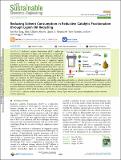
Reductive catalytic fractionation (RCF) enables the simultaneous valorization of lignin and carbohydrates in lignocellulosic biomass through solvent-based lignin extraction, followed by depolymerization and catalytic stabilization of the extracted lignin. Process modeling has shown that the use of exogenous organic solvent in RCF is a challenge for economic and environmental feasibility, and previous works proposed that lignin oil, a mixture of lignin-derived monomers and oligomers produced by RCF, can be used as a cosolvent in RCF. Here, we further explore the potential of RCF solvent recycling with lignin oil, extending the feasible lignin oil concentration in the solvent to 100 wt %, relative to the previously demonstrated 0-19 wt % range. Solvents containing up to 80 wt % lignin oil exhibited 83-93% delignification, comparable to 83% delignification with a methanol-water mixture, and notably, using lignin oil solely as a solvent achieved 67% delignification in the absence of water. In additional experiments, applying the RCF solvent recycling approach to ten consecutive RCF reactions resulted in a final lignin oil concentration of 11 wt %, without detrimental impacts on lignin extraction, lignin oil molar mass distribution, aromatic monomer selectivity, and cellulose retention. Overall, this work further demonstrates the potential for using lignin oil as an effective cosolvent in RCF, which can reduce the burden on downstream solvent recovery.
Date issued
2024-08-14Department
Massachusetts Institute of Technology. Department of Chemical EngineeringJournal
ACS Sustainable Chemistry & Engineering
Publisher
American Chemical Society
Citation
Jun Hee Jang, Júlia Callejón Álvarez, Quinn S. Neuendorf, Yuriy Román-Leshkov, and Gregg T. Beckham
ACS Sustainable Chemistry & Engineering 2024. 12 (34), 12919-12926.
Version: Final published version