| dc.contributor.author | Wang, Guanyun | |
| dc.contributor.author | Chen, Chuang | |
| dc.contributor.author | Jin, Xiao | |
| dc.contributor.author | Chen, Yulu | |
| dc.contributor.author | Zheng, Yangweizhe | |
| dc.contributor.author | Zhen, Qianzi | |
| dc.contributor.author | Zhang, Yang | |
| dc.contributor.author | Li, Jiaji | |
| dc.contributor.author | Yang, Yue | |
| dc.contributor.author | Tao, Ye | |
| dc.contributor.author | Luo, Shijian | |
| dc.contributor.author | Sun, Lingyun | |
| dc.date.accessioned | 2025-12-11T19:44:43Z | |
| dc.date.available | 2025-12-11T19:44:43Z | |
| dc.date.issued | 2025-04-25 | |
| dc.identifier.isbn | 979-8-4007-1394-1 | |
| dc.identifier.uri | https://hdl.handle.net/1721.1/164282 | |
| dc.description | CHI ’25, Yokohama, Japan | en_US |
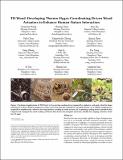
| dc.description.abstract | Wood has become increasingly applied in shape-changing interfaces for its eco-friendly and smart responsive properties, while its applications face challenges as it remains primarily driven by humidity. We propose TH-Wood, a biodegradable actuator system composed of wood veneer and microbial polymers, driven by both temperature and humidity, and capable of functioning in complex outdoor environments. This dual-factor-driven approach enhances the sensing and response channels, allowing for more sophisticated coordinating control methods. To assist in designing and utilizing the system more effectively, we developed a structure library inspired by dynamic plant forms, conducted extensive technical evaluations, created an educational platform accessible to users, and provided a design tool for deformation adjustments and behavior previews. Finally, several ecological applications demonstrate the potential of TH-Wood to significantly enhance human interaction with natural environments and expand the boundaries of human-nature relationships. | en_US |
| dc.publisher | ACM|CHI Conference on Human Factors in Computing Systems | en_US |
| dc.relation.isversionof | https://doi.org/10.1145/3706598.3714304 | en_US |
| dc.rights | Article is made available in accordance with the publisher's policy and may be subject to US copyright law. Please refer to the publisher's site for terms of use. | en_US |
| dc.source | Association for Computing Machinery | en_US |
| dc.title | TH-Wood: Developing Thermo-Hygro-Coordinating Driven Wood Actuators to Enhance Human-Nature Interaction | en_US |
| dc.type | Article | en_US |
| dc.identifier.citation | Guanyun Wang, Chuang Chen, Xiao Jin, Yulu Chen, Yangweizhe Zheng, Qianzi Zhen, Yang Zhang, Jiaji Li, Yue Yang, Ye Tao, Shijian Luo, and Lingyun Sun. 2025. TH-Wood: Developing Thermo-Hygro-Coordinating Driven Wood Actuators to Enhance Human-Nature Interaction. In Proceedings of the 2025 CHI Conference on Human Factors in Computing Systems (CHI '25). Association for Computing Machinery, New York, NY, USA, Article 745, 1–19. | en_US |
| dc.contributor.department | Massachusetts Institute of Technology. Computer Science and Artificial Intelligence Laboratory | en_US |
| dc.identifier.mitlicense | PUBLISHER_POLICY | |
| dc.eprint.version | Final published version | en_US |
| dc.type.uri | http://purl.org/eprint/type/ConferencePaper | en_US |
| eprint.status | http://purl.org/eprint/status/NonPeerReviewed | en_US |
| dc.date.updated | 2025-08-01T08:18:02Z | |
| dc.language.rfc3066 | en | |
| dc.rights.holder | The author(s) | |
| dspace.date.submission | 2025-08-01T08:18:04Z | |
| mit.license | PUBLISHER_POLICY | |
| mit.metadata.status | Authority Work and Publication Information Needed | en_US |