

Data-Driven AI Avatars for Valuation in Dating Scenarios
Download3706599.3719833.pdf (2.636Mb)
Publisher Policy
Publisher Policy
Article is made available in accordance with the publisher's policy and may be subject to US copyright law. Please refer to the publisher's site for terms of use.
Terms of use
Metadata
Show full item recordAbstract
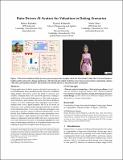
Dating applications facilitate partner selection by presenting curated information about potential matches. However, traditional dating profiles often fail to convey the depth of a person’s personality, communication style, and lived experience, leading to inefficiencies in the match-finding process. This work-in-progress study introduces and evaluates two novel, data-driven dating interfaces: (1) a Data Dashboard, which aggregates and visualizes insights from a user’s digital footprint, and (2) an AI Avatar, an interactive, voice-enabled model using personal data to simulate real-world interactions. A user study with nine participants comparing these interfaces against traditional dating profiles reveals that the Data Dashboard enables more accurate personality assessments but imposes a high cognitive load. Meanwhile, the AI Avatar enhances engagement and enjoyability but raises concerns about trust and emotional investment. Our findings highlight the challenge of maintaining authenticity in AI-mediated interactions and bridging the gap between digital and real-life personas.
Description
CHI EA ’25, Yokohama, Japan
Date issued
2025-04-25Department
Massachusetts Institute of Technology. Media LaboratoryPublisher
ACM|Extended Abstracts of the CHI Conference on Human Factors in Computing Systems
Citation
Dünya Baradari, Tejaswi Polimetla, and Pattie Maes. 2025. Data-Driven AI Avatars for Valuation in Dating Scenarios. In Proceedings of the Extended Abstracts of the CHI Conference on Human Factors in Computing Systems (CHI EA '25). Association for Computing Machinery, New York, NY, USA, Article 169, 1–13.
Version: Final published version
ISBN
979-8-4007-1395-8