

NeuroChat: A Neuroadaptive AI Chatbot for Customizing Learning Experiences
Download3719160.3736623.pdf (5.350Mb)
Publisher with Creative Commons License
Publisher with Creative Commons License
Creative Commons Attribution
Terms of use
Metadata
Show full item recordAbstract
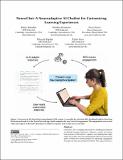
Generative AI is reshaping education by enabling personalized, on-demand learning experiences. However, current AI systems lack awareness of the learner’s cognitive state, limiting their adaptability. In parallel, electroencephalography (EEG)-based neuroadaptive systems have shown promise in enhancing engagement through real-time physiological feedback. This paper introduces NeuroChat, a neuroadaptive AI tutor that integrates real-time EEG-based engagement tracking with a large language model to adapt its conversational responses. By continuously monitoring learners’ cognitive engagement, NeuroChat dynamically adjusts content complexity, tone, and response style in a closed-loop interaction. In a within-subjects study (n = 24), NeuroChat significantly increased both EEG-measured and self-reported engagement compared to a non-adaptive chatbot. However, no significant differences in short-term learning outcomes were observed. These findings demonstrate the feasibility of real-time brain–AI interaction for education and highlight opportunities for deeper personalization, longer-term adaptation, and richer learning assessment in future neuroadaptive systems.
Description
CUI ’25, Waterloo, ON, Canada
Date issued
2025-07-08Department
Massachusetts Institute of Technology. Media LaboratoryPublisher
ACM|Proceedings of the 7th ACM Conference on Conversational User Interfaces
Citation
Dünya Baradari, Nataliya Kosmyna, Oscar Petrov, Rebecah Kaplun, and Pattie Maes. 2025. NeuroChat: A Neuroadaptive AI Chatbot for Customizing Learning Experiences. In Proceedings of the 7th ACM Conference on Conversational User Interfaces (CUI '25). Association for Computing Machinery, New York, NY, USA, Article 57, 1–21.
Version: Final published version
ISBN
979-8-4007-1527-3