| dc.contributor.author | Honnet, Cedric | |
| dc.contributor.author | Babatain, Wedyan | |
| dc.contributor.author | Luo, Yiyue | |
| dc.contributor.author | Kilic Afsar, Ozgun | |
| dc.contributor.author | Bensahel, Chloe | |
| dc.contributor.author | Nicita, Sarah | |
| dc.contributor.author | Zhu, Yunyi | |
| dc.contributor.author | Danielescu, Andreea | |
| dc.contributor.author | Gershenfeld, Neil | |
| dc.contributor.author | Paradiso, Joseph | |
| dc.date.accessioned | 2025-12-09T18:30:27Z | |
| dc.date.available | 2025-12-09T18:30:27Z | |
| dc.date.issued | 2025-09-27 | |
| dc.identifier.isbn | 979-8-4007-2037-6 | |
| dc.identifier.uri | https://hdl.handle.net/1721.1/164247 | |
| dc.description | UIST ’25, Busan, Republic of Korea | en_US |
| dc.publisher | ACM|The 38th Annual ACM Symposium on User Interface Software and Technology | en_US |
| dc.relation.isversionof | https://doi.org/10.1145/3746059.3747802 | en_US |
| dc.rights | Creative Commons Attribution-ShareAlike | en_US |
| dc.rights.uri | http://creativecommons.org/licenses/by-sa/4.0/ | en_US |
| dc.source | Association for Computing Machinery | en_US |
| dc.title | FiberCircuits: A Miniaturization Framework To Manufacture Fibers That Embed Integrated Circuits | en_US |
| dc.type | Article | en_US |
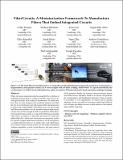
| dc.identifier.citation | While electronics miniaturization has propelled the evolution of technology from desktops to compact wearables, most devices are still rigid and bulky, often leading to abandonment. To enable interfaces that can truly disappear and seamlessly integrate into daily life, the next evolutionary leap will require further miniaturization to achieve full conformability. With FiberCircuits, we offer design and fabrication guidelines for the manufacturing of high-density circuits that are thin enough for full encapsulation within fibers. Our demonstrations include a 1.4 mm-wide ARM microcontroller with sensors as small as 0.9 mm-wide and arrays of 1 mm-wide addressable LEDs, which were woven into our interactive textiles. We provide example applications from fitness to VR, and propose a scalable fabrication process to enable large-scale deployment. To accelerate future research in HCI, we also made our platform Arduino-compatible, created custom libraries, and open-sourced all the materials. Finally, our technical characterizations demonstrate FiberCircuits’ durability, thanks to its silicone encapsulation for waterproofness and braiding for robustness. From wearables to insertables or even implantables, we believe that by making miniature circuits accessible to researchers and beyond, FiberCircuits will open possibilities for new scalable interfaces that embody imperceptible computing. | en_US |
| dc.contributor.department | Program in Media Arts and Sciences (Massachusetts Institute of Technology) | en_US |
| dc.contributor.department | Massachusetts Institute of Technology. Media Laboratory | en_US |
| dc.contributor.department | Massachusetts Institute of Technology. Department of Electrical Engineering and Computer Science | en_US |
| dc.identifier.mitlicense | PUBLISHER_POLICY | |
| dc.eprint.version | Final published version | en_US |
| dc.type.uri | http://purl.org/eprint/type/ConferencePaper | en_US |
| eprint.status | http://purl.org/eprint/status/NonPeerReviewed | en_US |
| dc.date.updated | 2025-10-01T07:55:36Z | |
| dc.language.rfc3066 | en | |
| dc.rights.holder | The author(s) | |
| dspace.date.submission | 2025-10-01T07:55:37Z | |
| mit.license | PUBLISHER_CC | |
| mit.metadata.status | Authority Work and Publication Information Needed | en_US |